
Why Am I Not Building Muscle?
You’ve been training consistently.
You’re lifting weights, trying different exercises, eating more protein, and maybe even taking supplements.
But when you look in the mirror, you’re still asking yourself:
“Why am I not building muscle?”
If that sounds familiar, you’re probably not missing some secret exercise or supplement.
In most cases, muscle growth comes down to a combination of training stimulus, nutrition, recovery, consistency, and progression.
The good news? You can usually identify what is holding you back—and fix it.
In this guide, we’ll break down the most common reasons you’re not gaining muscle and what you can do differently.
1. You’re Not Eating Enough Calories
One of the most common reasons people struggle to build muscle is surprisingly simple: they’re not eating enough.
Building new muscle tissue requires energy. If you’re training hard but consistently eating too little, your body has fewer resources available to support growth and recovery.
This doesn’t mean you need to eat everything in sight. A large calorie surplus isn’t necessary and can lead to unnecessary fat gain.
Instead, focus on eating enough to support your training while keeping your overall nutrition consistent.
If you’ve been maintaining the same body weight for weeks or months and your goal is to gain muscle, your current calorie intake may simply be too low.
What to do
- Track your food intake for a few weeks.
- Monitor your body weight and measurements.
- Prioritize nutrient-dense foods.
- Adjust calories gradually based on your progress.
Don’t rely on appetite alone to determine how much you’re eating.
2. You’re Not Eating Enough Protein

Protein provides the amino acids your body needs to repair and build muscle tissue.
If you’re consistently under-eating protein, maximizing muscle growth becomes more difficult.
Research examining resistance training and protein intake has found that increasing protein intake can enhance gains in lean mass and strength, with benefits tending to level off around roughly 1.6 g/kg/day in the analyzed data.
Other sports-nutrition guidance commonly places exercising individuals around 1.4–2.0 g/kg/day.
For example, someone weighing 80 kg might aim for roughly 112–160 g of protein per day.
The exact amount depends on your training, body composition, total calorie intake, goals, and individual circumstances.
Good protein sources include:
- Chicken and turkey
- Lean beef
- Fish
- Eggs
- Greek yogurt
- Cottage cheese
- Milk
- Whey or other protein supplements
- Legumes and soy-based foods
The important thing isn’t finding a “magic” protein source. It’s consistently getting enough total protein.
3. Your Workouts Aren’t Progressing
This is a huge one. You may be training hard—but are you actually progressing?
If you have been doing bench press — 60 kg × 10 — for months without increasing the weight, repetitions, sets, or improving your execution, your body may have very little reason to adapt further.
Muscle growth requires an appropriate training stimulus that develops over time. This is where progressive overload comes in.
Progression doesn’t necessarily mean adding weight every single workout. You can progress by:
- Increasing weight
- Performing more repetitions
- Adding productive sets
- Improving technique
- Increasing range of motion
- Improving control
- Getting stronger at the same repetitions
The latest ACSM resistance-training guidance emphasizes consistency, appropriate training volume, and gradually building the program around the individual’s goals. For hypertrophy, it highlights roughly 10 weekly sets per muscle group as a useful target rather than prescribing one rigid program for everyone.
4. You’re Changing Your Workout Too Often
New workout. New exercises. New split. New program. New “muscle-building technique.” Repeat.
If you change your training program every few weeks, it becomes difficult to determine whether your program is actually working.
Your body needs enough consistent exposure to a training stimulus for adaptations to occur—and for you to measure whether you’re improving.
You don’t need a completely new workout every Monday. Instead, build a structured program and track your performance.
Consistency beats novelty.
And this isn’t just a coaching cliché. The 2026 ACSM position stand specifically emphasizes consistency over complexity when designing resistance-training programs.
5. You’re Training Hard, But Not Training Effectively
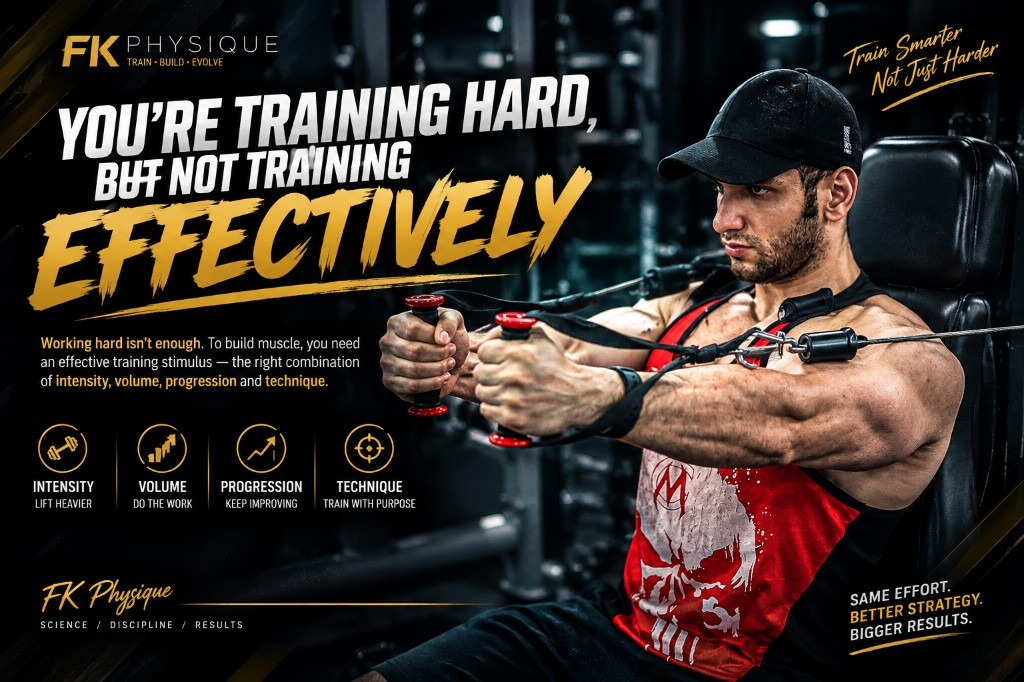
There’s a difference between working hard and creating an effective training stimulus.
Spending two hours in the gym doesn’t automatically mean you’re providing your muscles with a better stimulus.
Your training should have:
- Appropriate exercise selection
- Sufficient weekly volume
- Progressive overload
- Good technique
- Appropriate effort
- Adequate recovery
You also don’t necessarily need to take every set to absolute failure.
According to the latest ACSM guidance, advanced methods such as training every set to momentary muscular failure aren’t consistently necessary for the average healthy adult to achieve results.
The goal isn’t to make every workout as brutal as possible. The goal is to make every workout productive.
6. You’re Not Recovering Enough
You don’t build muscle simply because you lifted weights.
Training provides the stimulus. Recovery is where adaptation happens.
If you’re constantly training hard while getting poor sleep, managing high stress, and giving your muscles insufficient recovery time, your performance can suffer.
Sleep is particularly important for athletes and active individuals. Research and expert consensus indicate that inadequate sleep can negatively affect performance and recovery, although individual sleep needs vary.
Instead of obsessing over a universal number, pay attention to your individual needs and sleep quality.
Aim for:
- Consistent sleep and wake times
- Enough total sleep to feel recovered
- A good sleep environment
- Less screen exposure before bed
- Appropriate rest between demanding training sessions
7. You’re Doing Too Much Cardio
Cardio isn’t the enemy of muscle growth. In fact, cardiovascular fitness is an important part of overall health.
The problem can occur when your cardio volume becomes excessive relative to your recovery and calorie intake.
For example, if you’re lifting five days a week, running long distances several times per week, eating too little, and sleeping poorly, your recovery demands can become difficult to manage.
If muscle growth is your primary goal, your entire training program should support that goal.
That means balancing resistance training + nutrition + cardio + recovery, rather than treating each component independently.
8. You’re Underestimating How Long Muscle Growth Takes
This might be the most frustrating answer: you’re expecting results too quickly.
Muscle growth isn’t an overnight transformation. Stay consistent, fix the fundamentals above, and give your program enough time to work.